About Me

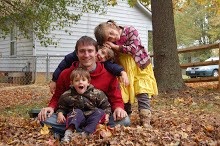
My photo
Born: Toccoa, GA. Raised: Internationally. Married to the best woman ever, Amanda! 3 children (1 girl, 2 boys). My parents are missionaries, and I was raised mostly in Guinea and Ivory Coast, West Africa. I personally came to know Jesus Christ at a very young age, when He saved me from my sins by His own death on the cross. He has been teaching me to love God and others since then.

Wednesday, October 3, 2007

Emma's Timing

October 3, 2007


This morning Christy and I were talking about whether to allow Emma to use finger paints indoors. I said that I would prefer to allow Emma to use her play-doh at the table. Christy responded, “Really? I would think that finger paints are better indoors. Play-doh is harder to get out of the carpet.”


At which point Emma looked at me and said matter-of-factly, “Yeah.”


Shows how much I know.


Tuesday, October 2, 2007

Mark 15:1-5

Recently I have read about Jesus' trials several times. I am repeatedly struck by the fact that the only charges to which Jesus responded were charges about whether He was the Messiah or the king of the Jews (pretty much the same thing). When questioned about this, Jesus responds affirmatively every time.  Otherwise, Jesus keeps quiet.


Apparently, this is the one question that matters. Is Jesus the king of the Jews, predicted by the prophets? Or not? Jesus says that He is. Jesus died claiming to be the Messiah. His disciples later died telling people that Jesus was still the Messiah, that death had not been victorious over Him.


If He is the Messiah, then all humanity can be restored through Him, and the entire world order will one day be subject to Him. If not, then we need not worry about following Him any more than some other ethically-positive teacher. But if He is the Messiah... He is worth following! He is worthy of my service, my love, the strength of my life!


If you're reading this and you're uncertain about Christianity, this is the one question for which you should find an answer: Is Jesus the Messiah or not? Figure that one out and everything else will follow from your answer.


Monday, October 1, 2007

Emma

I don’t know exactly what I want to say here, but I love Emma so much! She’s almost two, and she’s getting more two-ish day by day. She likes the word “no” a bit more than I would want her to like it. She screams sometimes to get our attention, rather than talking. But she’s got so many good points.


Last night, we took her to visit some friends of ours. She was having a hard time playing well with their kids, mainly because she was very hungry, so I took her to buy some crackers. And she ate a lot of them. She started sharing them with everyone. She offered them to the other kids. She offered them to our friends. I think she even offered them to Michael, though we obviously couldn’t let her continue that for very long. When she’s not hungry, though, she loves sharing. It’s a beautiful sight.


Josh (our friend) had a harmonica, and he was playing it. Emma LOVED what he was doing. She danced as he played, and squealed with delight. She made the music so much better just because of how much she enjoyed it. Josh played longer just because it made him so happy to see her so happy. Having a daughter like Emma is so nice.


We kept her up late while we were there, not leaving until 10:30. But she stayed contented and sweet all the way to the end (95% of the time, I would say). How often does that happen with a kid so young?


Mark 14:66-72

There's something to be said for Peter, even in the midst of this terrible account of his denial: Peter immediately recognized his sin. He was convicted of his sin as soon as the cock crowed the second time, because he remembered that Jesus had predicted these denials. He wept.


In contrast, too often we take our sins lightly. Jesus died for us, we reason, and yes, it's terrible that we've sinned. But ultimately, we're ok. We're already saved, and we know He's paid for our most recent sins, too. We begin to take God's forgiveness for granted. We don't weep over the seriousness of our sins.


Our salvation was not intended to make our sins look any less despicable to us. Sins are still sins. We should be more horrified at our sins after our salvation, not less! No longer are we horrified because we believe that we will be sentenced to hell. Now we are horrified because we understand more fully the foolishness of sin, the results of sin, the offense of sin before our wonderful, holy Father and Lord. We wonder how we can continue to sin, now that we are saved, now that we have been given the Holy Spirit to empower us against sin, now that we understand the evil-ness of sin. We see how powerful sin is in our lives, even now, and we are driven to realize more fully how powerful God must be to have saved us and be saving us from our sinful ways.


Sin is never a light matter. Father, forgive me for my offenses! And forgive me for not dealing with them as I ought to! Deliver us all, and make Your name great in our eyes every time we see the operations of sin in us and around us! May we know that You alone are upright and good, and may we fall down before You to seek Your mercy! May we weep over our sins!


Friday, September 28, 2007

Mark 14:43-52

There's no doubt about it. Even in the midst of evil actions, we humans like to pretend we're in the right.


This passage highlights our self-deception twice, first through Judas and then through the crowd that came to arrest Jesus.


Judas was performing one of the most wicked deeds ever performed in the history of the human race; he was betraying the Son of God into the hands of His enemies. But even with a crowd at his back, Judas did not have the courage to look Jesus in the face and say, "I brought them here to arrest you." Instead, he greeted Jesus and kissed Him, just as though their relationship was perfectly solid. Did he think that Jesus was blind? That He didn't see a huge crowd with swords and clubs? Did he think that Jesus was dumb? That He couldn't figure out that Judas had led them here, or that He wouldn't realize that the men who stepped forward to arrest Him did so because Judas identified Jesus as the one they were after? No. Rationally, Judas knew that everything was plain and clear. He was betraying Jesus. Judas was identifying Jesus, handing Him over to His enemies. But Judas was trying to make himself feel better about the whole thing by putting on a facade of friendliness. He was pretending, to salve his own conscience, that he was living life rightly.


What about the crowd? They came to Jesus in the middle of the night with swords and clubs to arrest him. Jesus pointed out their hypocrisy right away. Couldn't they have arrested him during the day? After all, wasn't he a public figure? He wasn't trying to hide from them, like a robber might. He had been spending his time in the temple courts, easily found in broad daylight in the city of Jerusalem. So why would they go to all this trouble to wait until the middle of the night, when they would usually have been sleeping? Why would they come with swords and clubs to arrest a man who wasn't violent? The truth of the matter was that coming in the middle of the night made them feel like they were after a dangerous criminal. Arresting him while carrying swords and clubs helped them sense that Jesus was someone to fear, and that they were right in their actions. If they had arrested him in broad daylight, it would have been all too plain to everyone that their actions were immoral.


How easily we men deceive ourselves and justify our actions! How foolish we are, and how scared to admit our sinfulness!


Father, send the light! Help us to see the truth. Make us incapable of hiding our evil intentions and actions any longer. Make us fall on our faces, dismayed at the thought that Your wrath is deserved – every bit of it! And when we think that all hope is lost, show us Your love. Show us how while we were still sinners, Christ died for us! Make us a humble and grateful people, amazed at Your patience with us. And teach us to walk always in the light.
 

Thursday, September 27, 2007

Mark 14:32-42

I am struck every time I read this by Jesus' anguish as He prepares for His death. I'm sure He knows the plan. Give yourself up, suffer, die, rise again. He has tried to teach this plan to His disciples several times to prepare them for what was to come. If Jesus were only divine, and not at all human, this turmoil would probably not be so evident. But Jesus was/is fully man. Just as we suffer when we scrape our knees or eat food that is too hot, so did He. He was no more eager to suffer physical pain than any of us are. The body's desire to maintain itself and protect itself was alive and well in Jesus. He had no personal desire to be flogged; he genuinely feared the pain, a pain far worse than the spankings we so greatly fear in our childhood.


In light of this, He still says, "Not my will, but Yours." Without even knowing what God is asking of us – without knowing that God intends anything but good for us – we fear to say these words. God's plan for my life might never involve prison, or floggings, or beatings, or torture, or painful death. Why do I act as though I believe God intends for me to experience pain each and every day? Why do I struggle to say, "Not my will, but Yours?"


One note of encouragement. Jesus feared pain, too. In other words, God does not despise us for fearing pain. He designed us to hate pain, and in most circumstances we are to avoid it. All God wants is our faithfulness – not a form of courage that scoffs at pain. He wants our obedience for the sake of His kingdom – not as robots, but as people who must trust Him enough to override their built-in (by Him) desires.


Father, thank You for not being upset with us when circumstances make us think twice about what You are calling us to do. Thank You also that You reveal Your will clearly enough that we can face great pain when we need to, testifying to unbelievers that there is more to life than personal comfort and safety.


Tuesday, September 25, 2007

The Body, the Blood, the Future Drinking of Wine

Mark 14:22-26


There’s no commentary in these verses. There’s no place where Jesus says something like, “When I tell you that this is my body, what I mean is... When I tell you that this is my blood of the covenant, what I mean is...” The commentary comes at the cross. After the cross and resurrection, after Jesus taught His disciples the full meaning of all these things, they were able to understand that Jesus really had come to die for us all. His body and blood were broken and poured out for us.


Why? For a renewed future. Jesus says in this passage that He will not drink wine again until he drinks it “new (kainon)” in the kingdom of God. It may be legitimate to believe that Jesus was merely saying, “One day I will drink wine with you again, once the kingdom is here.” But it seems even more appropriate to understand that Jesus was communicating something about that kingdom. The wine He would drink in that kingdom would be new wine. Jesus came to redeem the world. Not only will those who believe in Him be redeemed and restored. A new heavens and earth will be put in place. The wine in that time will be better wine in every way than any wine men have experienced since the Fall. And the new wine Jesus here speaks about is just one example of the myriad of ways in which that world will be better than the world we live in now.


Jesus gave His body and His blood for us, to bring us into the perfect, new kingdom of God. He makes all things new. And we get to be part of it!